
Starting Points for Teaching World Religions

Click here to order.

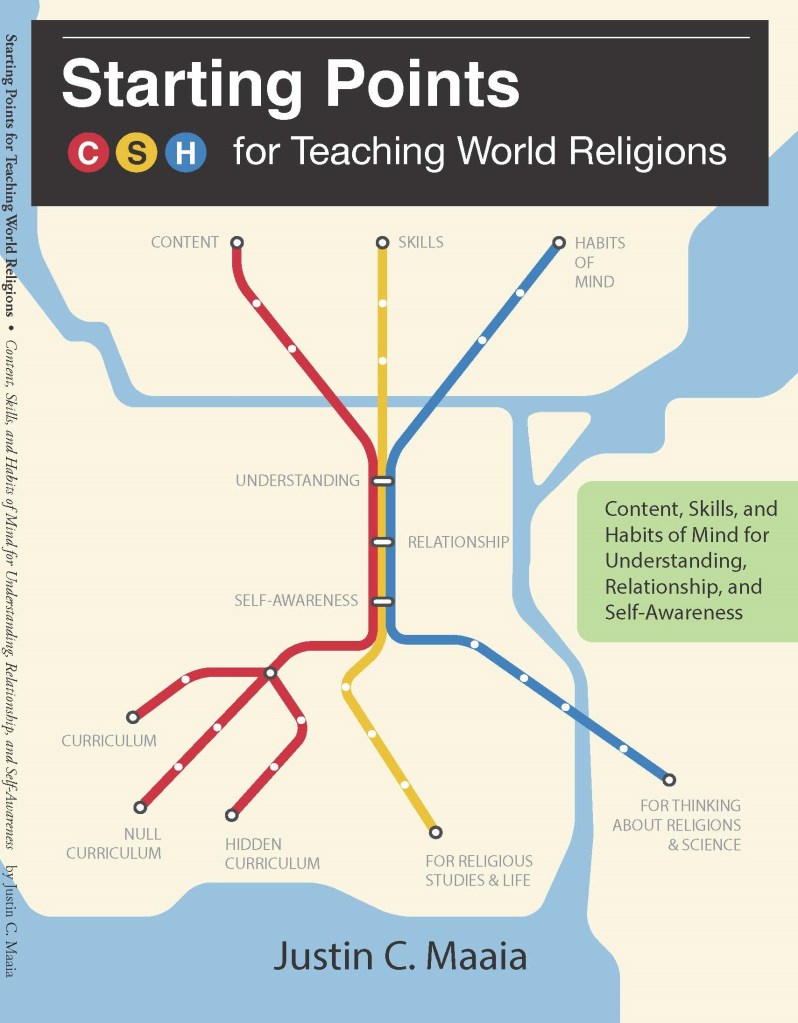
In 2020, when I was applying to be a visiting scholar for the Center for Spiritual and Ethical Education, I proposed writing a book for new religious studies teachers. I wanted to write the book I had wished was available to me, both as a student studying religion in college and graduate school, and as a new teacher in the field. The CSEE accepted my proposal and the result is Starting Points for Teaching World Religions: Content, Skills, and Habits of Mind for Understanding, Relationship, and Self-Awareness

The book is divided into three sections:

1. A brief history of the field of religious studies as it developed in the Western academic tradition. Walter Capps’ book “Religious Studies: The Making of a Discipline” is a much more thorough history, but I found it too long for someone who is new to the discipline and who needs a sense of the overall story and major developments. Capps’ book is the reference text and the deep-dive for the graduate student; mine is the primer.

2. An explanation and evaluation of the several approaches to teaching about religion that have emerged over the centuries. What are they? What are their advantages and limitations? How might we use several of them together in a course?

3. A sample curriculum, including: a) a detailed unit plan for an Introduction to Religious Studies, b) a detailed plan for a thematic unit (mystical experience), c) a detailed plan for a unit on a specific religion (Christianity), 4) a list of vocabulary, common misunderstandings, and considerations for teaching about five of the most commonly taught religions (Buddhism, Christianity, Hinduism, Islam, and Judaism)

Starting Points is here! Click HERE to order!


Praise for Starting Points

“Justin Maaia has written a substantial and urgent book on learning about and teaching religion. Our world torn apart with ethnic and religious conflicts and living under the existentialist threats of climate change and theories of end of times, this is a book that offers good sense and hope. It is indispensable reading.”

Akbar Ahmed, Distinguished Professor and Ibn Khaldun Chair of Islamic Studies, School of International Service, American University and Global Fellow, Wilson Center.

Starting Points is a wonderful book—clearly written, incisive, thoughtful, and comprehensive. Justin Maaia guides readers through the incredibly complex phenomenon of religion in the world today and its remarkable influence on human cultures and societies around the globe. It will be an invaluable resource to religion teachers as well as social studies and history teachers, advanced undergraduate and graduate students in Religious Studies & Theology, and members of religious communities interested in inter-religious dialogue, as well. Anyone seeking to understand religious and spiritual traditions will find a marvelous resource in this insightful work.”

Erin M. Cline, Paul J. and Chandler M. Tagliabue Distinguished Professor in Interfaith Studies & Dialogue, Georgetown University, and Senior Research Fellow, Berkley Center for Religion, Peace & World Affairs.

“An unexpected assignment from the principal or head of school can cause anxiety, even panic. Especially if she has asked you to teach a course on world religions. And you’ve never taught such a course before. Nor taken as much as a college survey course on Christianity, Islam, or Buddhism.

Not to worry. Your tutor has arrived. Justin Maaia opens his well-traveled suitcase of books, articles, pamphlets, online links to unusual resources, videos, films, TV programs, sample curricula, best practices, sample syllabi, even sample tests. Most importantly, he lays out the key issues and approaches to consider when introducing a religious tradition to a class of teenagers. His voice is engaging, conversational, and collegial. His 20 years of teaching shine through. You can relax. You’re in good hands.”

Andrew D. Scrimgeour, Ph.D., Archivist Emeritus, Society of Biblical Literature and Dean of Libraries Emeritus, Drew University.

“Justin Maaia does all of us who teach a course on World Religions a great service with this practical guide on how to teach and model the Study of Religion in the classroom. While there are more than enough textbooks that provide factual information on a wide range of religious traditions around the world, none of them equip students with the skills to actually do the Study of Religion. Based on many years of classroom experience and deep reflection on the theoretical and historical basis of religious studies, Maaia offers here tips and insights on how to structure a course that goes way beyond imparting the basic facts about the major world religions. Instead, Maaia aims at teaching students how to think, reason, and investigate like true scholars of religion. The book is filled with tried-and-true classroom activities and fieldwork suggestions that will engage your students like never before.”

Jacco Dieleman Ph.D., History and Social Sciences, Holton-Arms School.


An excerpt from Starting Points:

Phenomenology is the study of things as they appear to me, at this place and time. Every time we observe a religious phenomenon, we are seeing it and judging it as it compares to our own expectations based on our experiences, values, and preferences. I will never forget when a friend of my brother’s first visited the Roman Catholic church where my brother and I grew up. She was startled by all the statues and stained-glass images, and she told me how she felt—like she was in a pagan temple where people worshipped all kinds of gods in all kinds of statues and images. Her reaction struck me as so odd because I had grown up with these statues and images and from a young age had the understanding that none of these things are idols, but rather ways of focusing a person’s attention on the one God. My friend, however, grew up in a Congregational church devoid of all images of human form, and her ability to observe and judge what was happening in an unfamiliar space was negatively affected. Hence, a religious studies scholar, more than any other type of scientist, needs to practice phenomenology.

Next we need to examine how we do phenomenology. I like to explain the process in three steps:

1. Awareness: We need to bring our perspectives, opinions, biases, and prejudices (prejudgments) to awareness.

2. Bracketing: We need to “bracket out” our perspectives, opinions, biases, and prejudices as best we can, acknowledging them so that they do not obstruct our trying to understand what we are observing.

3. Language: We need to use the least value-laden language possible to describe what we observe in the most neutral way we can.

Without phenomenology, if I visit a Buddhist community, I might observe and write in my notebook, “Monks sitting on the floor praying to Buddha.” If I am in a Pure Land Buddhist monastery, I may be right, but if I am in a Theravadin Buddhist vihara I would be wrong. Many Pure Land Buddhists do ask Buddha (and other powerful awakened beings called bodhisattvas) for help, and they do hope to be reborn in a kind of heaven from where it will be easier for them to reach nirvana in their next life. However, most Theravadin Buddhists believe that Buddha was just a human being who showed them the way to live their lives to achieve nirvana in this life, at which point they will cease to exist as they do now.

How do I avoid this pitfall of misjudgment? Through the three steps of phenomenology: If before entering the Buddhist service I take a minute to remember that I was raised Roman Catholic and that this experience will influence how I will interpret what I see when I enter any other religious site, I will be aware of my propensity to view religious phenomena through my Roman Catholic lens: silent sitting is most likely prayer, statues are most likely depictions of supernatural or saintly beings. After bringing these prejudgments to awareness and bracketing them, in my notebook I would write, “People dressed in robes, who appear to be monks, sitting on the floor in front of a statue of a cross-legged person that appears to be Buddha.” Then, armed with this self-aware, humble observation, encoded in value-less language, I will be prepared to make inquiries that will flesh-out what I have observed with reliable knowledge instead of my mistaken assumptions. I will be aware of my need to do further research, either in the library or in the field, to add detail and clarity to what I have observed.

At this point, my students usually (hopefully) raise some objections. How can we bring to awareness things of which we are unaware? Even if we succeed in doing so, how do we ever truly bracket these prejudgments? And, finally, does value-less language even exist? Doesn’t every word have connotations?

I affirm these objections, and I answer that it is highly possible that this phenomenological method is impossible to achieve. I explain that it is a practice. We may never achieve the ideals of perfect awareness, perfect bracketing, and valueless language, but that doesn’t mean we cannot or should not try, or that there aren’t important, valuable gains to be made in the process of trying. It is my experience and the experience of countless others that this practice of phenomenology leads to better observations, better questions, better insights, better understandings, better relationships, better empathy. As the wise saying goes, we should never let the perfect be the enemy of the good.

Why do we have this habit of making snap judgments (“prejudgments” or “prejudices”) that is so detrimental to religious studies, not to mention to our understanding of other people? For one thing, I would like to point out Hans-Georg Gadamer’s insight into the value of prejudgments. Gadamer said that one of the Enlightenment’s faults was its prejudice against prejudice. He, of course, wasn’t referring to prejudice against groups of people. He was referring to the Enlightenment’s naïve belief in the possibility of a perfectly neutral, objective, and universal observation. Gadamer held that prejudgment is actually the key to understanding, that it is always there, and that it gives us our first, if erroneous, understanding (or misunderstanding, as the case may be) of whatever we encounter. We start with this initial (mis)understanding, which we then modify or confirm as we gain new information, leading to a more accurate understanding or judgment (rather than prejudgment). Prejudgment only remains a problem if we remain mired in it, never move beyond it, never recognize it as “pre,” and never seek to modify it properly. Phenomenology is a method of ensuring we are always alert to prejudgment.

Why is this practice of phenomenology so difficult for us as human beings? Because we have evolved to do the exact opposite, because one of the reasons we have survived as a species is precisely by doing the opposite. When our ancestors heard a rustling in the bushes, they stopped and shouted “BEAR!” and they ran as fast as possible in the opposite direction. We survived because we evolved to make the snap judgments that led us to safety, even if that meant a few unnecessary flights from the neighbor’s domesticated dog. We didn’t hear the rustling and stop to ask, “What are the prejudgments that are leading me to think this is a bear?” and “Shouldn’t I describe this sound as a rustling rather immediately labeling it ‘BEAR’?”

Yet here we are, in religious studies, asking ourselves to do the exact opposite of the survival skill that is rooted in millions of years of evolution. Instead of running in the opposite direction in panic, we strive to stand still and even to move closer to that which is different from us. Rather than shouting an alarm, we seek to carefully describe things in the most neutral language possible. Instead of relying on our prejudgments, we courageously suspend judgment and see things sympathetically.

How is it possible to accomplish this difficult task? That question brings us to another of our evolved traits: the ability to work together across differences, to build relationships, to make connections. Our species did not survive only because we could make snap judgments, nor because we could run long distances or invent effective weapons. We survived because we learned how to get to know one another and to work together in relationship.[1] It is ironic that one of the traits that allowed us to survive for 300,000 years is the same trait we must transcend in order to survive and thrive for the next 300,000 in our globalized, multicultural world.[2] This is why I know that, as difficult as the practice of phenomenology can seem, this practice is one we can and should rely on, not only to be good religious studies scholars, but to be good human beings. Indeed, the future of our species and our planet depends on it.[3]

Excerpt taken from Starting Points for Teaching World Religions: Content, Skills, and Habits of Mind for Understanding, Relationship, and Self-Awareness, published by the Center for Spiritual and Ethical Education.


[1] See Jonathan Haidt’s The Righteous Mind: Why Good People Are Divided by Politics and Religion for arguments and evidence for the evolutionary value of working together in groups. Though his treatment of religion overall suffers from reductionism, how he describes this particular positive functioning of religion is spot-on.

[2] I am always sure to explain to students that “transcending” snap judgments doesn’t mean getting rid of them altogether. We should learn to pay attention to our gut instincts and to decide when to follow them and when to override them. If we are caught in the woods and we think we hear a bear approaching, this is not the time to practice phenomenology.

[3] To illustrate to students how phenomenology is a practical skill for their lives beyond religious studies, I usually say something like, “If I am a person who doesn’t like face piercings, and I see someone with face piercings, I am likely to avoid them or to unconsciously give them a disgusted look. But if I practice phenomenology, I will note my dislike for face piercings and I will make a conscious choice to move toward that person, shake hands with them, and introduce myself. While talking with them, I might learn that they are into philosophy and religion. Soon, I become friends with them and I don’t even notice the piercings anymore.” This is almost exactly what happened to a former student of mine during her first year of college.

https://justincmaaia.substack.com/p/the-study-of-things-as-they-appear